Guarding against Tax Preparer Fraud
Kevin Rego • July 9, 2023

San Mateo, CA: You might want to consider professional Tax Account Transcript Monitoring to make sure your returns are filed with the information you provided.

Most of us think of the professionals that prepare our annual tax returns are honest, hard-working, and trustworthy folks-otherwise, we would not go to them with our sensitive tax information.

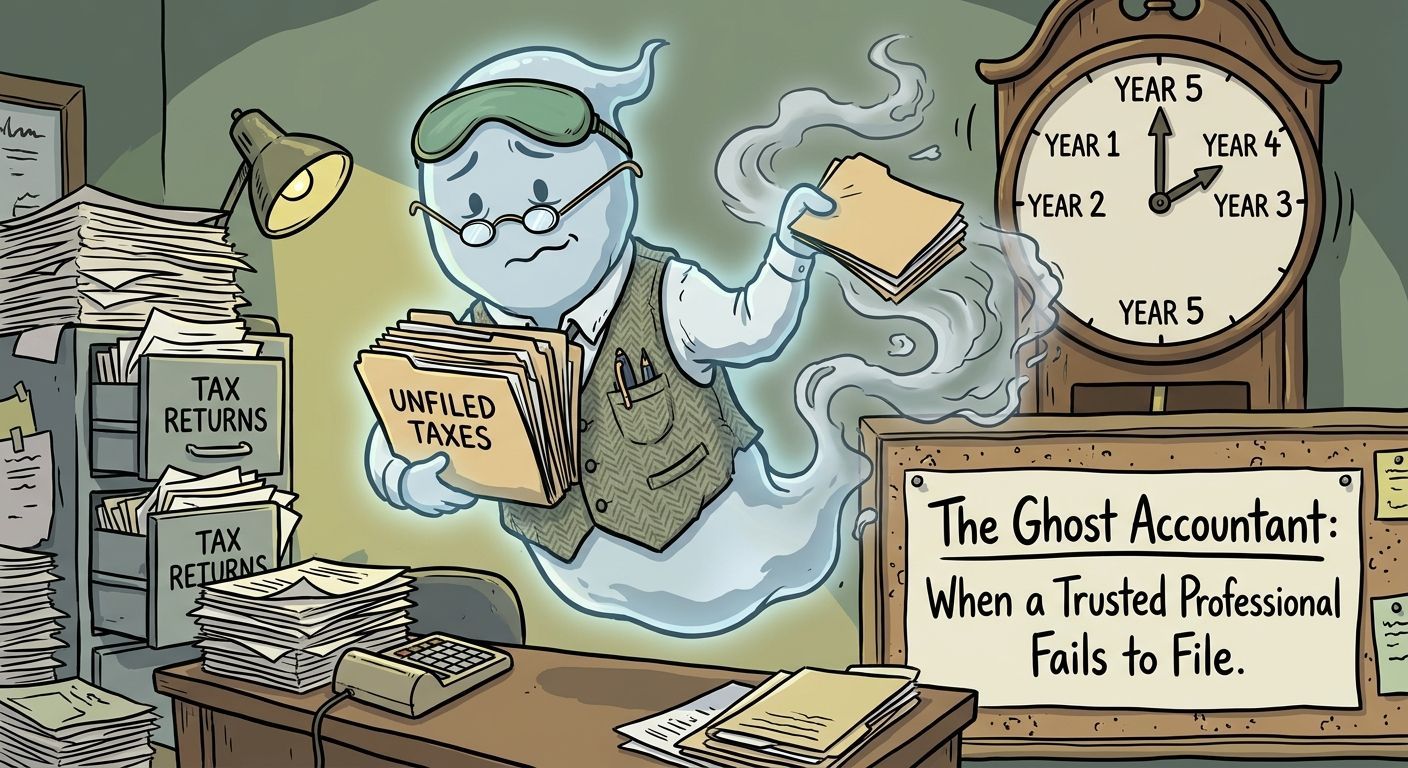
But, what if that trust is misplaced?   What if the tax professional we have prepare our tax returns goes rogue?  Who is on the hook?

I had a recent case that I would like to highlight here.  It begs the need for the each taxpayer to be diligent in handling their tax affairs.

Taxpayer, call her Sue, went has been going to the same preparer, call him Andy, for 7 years.  Never had a problem in the past--Andy is a great guy.

This year, Sue gets her copy of the tax return from Andy and everything is OK.  Sue gets her refund, everything is good--just like every year.

An issue arises with Sue that she needs to contact the IRS regarding a different matter unrelated to the tax return.  In speaking with the IRS representative, she finds out that there is information on her tax return that she was not aware of.  IN FACT, Sue finds out that the refund was NOT just the amount she received in her bank account direct deposit, but there was a second "SPLIT ACCOUNT" that deposited a portion of her tax return refund into a bank account she did not recognize.  The IRS cannot explain to her why this happened--only that it did.  They refer her to the Taxpayer Advocate Service.  The Taxpayer Advocate Service advised they were so backlogged it would be several weeks or months until someone could call her back.

Sue came to me for help.  I pulled Sue's IRS account transcripts and immediately saw the issue.  In comparing Sue's IRS return transcript with the copy she had been given by Andy, I saw huge discrepancies.  I saw that Sue's deductions had been grossly increased and credits that Sue was not eligible for were taken on the return.  I also saw that the refund was split into to different accounts---and the amounts that went into both accounts.

Sue got her expected refund, but her crooked tax preparer stole the bounty of refund given by the false deductions and false credits.

Bottom line:  There is no place in the tax system for crooked preparers.  This preparer not only stole from the government, he stole IN THE NAME OF SUE--hiding behind his client that he has a duty to represent properly.

It got me thinking how valuable I RS account transcript monitoring  really is.  I was able to immediately identify the fraud and we taking steps to not only fix the issue for Sue (realize--the IRS has no idea what happened here so Sue is on the hook until we can prove otherwise) but we are making sure that the IRS and other professional licensing organizations that Andy belongs to are apprised of the situation.  

Who knows how many other unsuspecting Andy victims are out there?  Andy had a storefront tax preparation service that served hundreds of clients.  Sue had NO INDICATION based on her prior years of business with Andy that he would do this to her.

The point of my story:  Beware and protect yourself.  Sue would never have know that she was being used to defraud the government until she got the audit letter in the mail.  By that time, she is not only fighting the IRS to prove her innocence, she is trying to figure out what happened.

This also area is also ripe with fraud with businesses being victimized by employee embezzlers who steal trust fund monies for employee benefits.  But that is a blog story for another time!

If you suspect something just isn't right with your tax preparer, drop me an email or phone call and I will see if I can help.

Kevin Rego


Disclaimer: The information provided is intended to provide a general overview of the topic presented.  It is not intended to be a legal interpretation of your individual tax or legal situation.  If there is a conflict between the information provided and any legal authority implementing or interpreting the topic, the legal authority shall prevail.  Always seek legal advice from a licensed attorney.  This article does not in anyway establish an attorney-client relationship.  That relationship can only be accomplished with both parties signing a mutual, written agreement.

By Kevin Rego June 9, 2026
San Mateo, CA I usually write about IRS tax problems since my practice centers around IRS collection and audit resolution , however every once in a while some interesting tax and financial related items come across my desk that I think are worth mentioning. If you have kids in high school looking ahead to college or kids in college looking at graduate school and you are wondering--how will I pay for this---this is article is for you. Student Loan Changes are in effect: Starting this July, the way students borrow money for college and graduate school is getting a significant overhaul. New rules will reshape borrowing limits, phase out certain loan types entirely, and for the first time, draw a sharper line between graduate and professional degrees when deciding how much a student can take on. Most of these changes kick in July 1, 2026, and affect federal loans first disbursed for the 2026–2027 academic year. If your kids are already in school, take a breath — many of these rules won't touch you. They're largely aimed at incoming students. Undergraduate borrowing? Nothing changes. For all the commotion surrounding these program reforms, undergraduate loan limits are staying exactly where they've been. Federal Direct Loans remain the main-stay of student aid for four-year programs, and the annual caps haven't moved. Here's a basic breakdown: Dependent students can borrow up to $5,500 in their first year, $6,500 in their second, and $7,500 annually after that. Independent students get more room — $9,500 in year one, $10,500 in year two, and $12,500 per year from there on. Lifetime caps sit at $31,000 for dependent students and $57,500 for independent ones. These numbers haven't budged in years, and since they're not tied to inflation, they now cover a noticeably smaller slice of what college actually costs than they once did. Dependent or Independent--What does that mean: Whether a student qualifies as "independent" matters quite a bit here, since that status unlocks higher limits. Under Section 480(d) of the Higher Education Act, you're considered independent if you're 24 or older, married, have dependents of your own, are enrolled in a graduate or professional program, have served in the military, are an emancipated minor or ward of the court, grew up in foster care, or are a homeless youth — among a few other qualifying circumstances. Because loans rarely cover the full bill anyway, most undergraduates piece together the rest through scholarships, grants, family contributions, 529 savings plans, part-time jobs, and sometimes Parent PLUS or private loans. Graduate students are facing the biggest changes. This is where the 2026 reforms really have a bite. Under the old system, graduate students could stack Direct Loans on top of Graduate PLUS Loans, which allowed borrowing all the way up to the cost of attendance — tuition, housing, food, everything. That flexibility is gone . Graduate PLUS Loans are being eliminated for new borrowers. Going forward, most graduate students will be limited to $20,500 per year, with a lifetime cap of $100,000 for all graduate borrowing. There is an exception carved out for a narrow tier of professional degrees: medicine, dentistry, law, and a few others. Those students can borrow up to $50,000 per year and $200,000 over the course of their studies. Worth noting: unlike before, these new caps aren't pegged to the cost of attendance. That means federal loans may no longer stretch far enough to cover both tuition and living expenses, leaving students to find other ways to fill the gap. Families borrowing through Parent PLUS loans will feel it too. The changes don't stop with students. Parent PLUS loans — long used as an additional source of college funds— are also getting capped. Where parents could previously borrow up to the full cost of attendance, they'll now be limited to $20,000 per year per child, with a lifetime ceiling of $65,000 per student. Since these loans land on the parent's credit and the parent is responsible for repayment, families who've relied heavily on Parent PLUS to afford higher-cost schools may find themselves rethinking their options. Scholarships, savings, and more affordable educational pathways are likely to become a bigger part of the conversation going forward. Have questions about how this affects your family? These changes may not show up on a tax return, but they're very much a part of your financial picture. Where loans in the past have made up a large part of financing college tuition and living expenses, new changes may limit those options. Remember to always verify your circumstances with a college financial planner or college advisor. These are general provisions designed as an overview of changes. Your individual circumstances may vary. Kevin Rego Law Office of Kevin Rego 650.933.5222  Disclaimer: The information provided is intended to provide a general overview of the topic presented at the time of publication. Tax laws change and you should always consult a tax professional for the latest tax law. This article is not intended to be a legal interpretation of your individual tax or legal situation. If there is a conflict between the information provided and any legal authority implementing or interpreting the topic, the legal authority shall prevail. Always seek legal advice from a licensed attorney. This article does not in any way establish an attorney-client relationship. That relationship can only be accomplished with both parties signing a mutual, written agreement.
By Kevin Rego May 18, 2026
A recent U.S. Tax Court case is a cautionary tale every taxpayer who takes a charitable donation deduction on their annual tax return needs to hear. A couple donated a piece of land worth thousands of dollars to their city in the state of Utah. They had letters, a deed, city council records — a whole file of documents showing the donation was legitimate. They filed their tax return with the donation deduction and that is when things went haywire. The IRS disallowed the entire deduction. In subsequent litigation challenging the disallowance, the US Tax Court agreed with the IRS. Not because the donation was not real. Not because the land had no value. But because the paperwork did not say the right things. Here is what you need to know to protect your deduction. The Magic Number Is $250 If your charitable contribution — cash or property — is $250 or more, the IRS requires a Contemporaneous Written Acknowledgment (CWA) from the charity. “Contemporaneous” means you must have this document (1) on or before the date you file your return or (2) the due date of the tax return — whichever is earlier. Without it, if your charitable deduction is challenged by the IRS, your deduction is likely gone. What the Letter MUST Contain Under I.R.C. § 170(f)(8)(B), the CWA must include all three of the following: A description of what you donated. For cash, state the dollar amount. For property, describe what was received by the charity. The charity does not need to state the value — but they must describe what they got from you. An affirmative statement about whether the charity gave you anything in return for the donation. This is the one that trips up ALOT of taxpayers. If the charity gave you nothing — no dinner, no tickets, no tote bag — the letter must say so explicitly. Words like “donation” or "thank you" or "acknowlegement" or “gift” are not enough. The required language is simple: “No goods or services, in whole or in part, were provided in exchange for this contribution.” Silence on this point will cost you your deduction. If the charity DID give you something in return for the donation, it must be described and include an estimate of the value of what you received. For example: “Two gala dinner tickets with an estimated fair market value of $150 were provided in return for your charitable donation of $500”. For contributions to religious organizations or houses of worship, a statement to the effect of such goods or services consist solely of "intangible religious benefits" is often appropriate in this part. Close Is Not Good Enough In many areas of tax law there is a concept called substantial compliance — meaning if you got close enough, the IRS would cut you some slack. That doctrine does not apply here. The CWA requirements are strict, and a deduction will be disallowed in its entirety if the letter falls short — even if the donation was completely genuine and legitimate, like our couple from Utah. Before You File — Make sure everything is in order If you have made a significant charitable contribution and are not certain your acknowledgment letter meets the IRS requirements, contact the qualified charity before you file. It is far easier to get a revised or re-worded letter from the charity before your return goes in than to fight the IRS afterwards. If you've received an IRS letter or notice that and you're not sure what to do next, contact my office today for a consultation. Kevin Rego Law Office of Kevin Rego 650.933.5222 Disclaimer: The information provided is intended to provide a general overview of the topic presented at the time of publication. Tax laws change and you should always consult a tax professional for the latest tax law. This article is not intended to be a legal interpretation of your individual tax or legal situation. If there is a conflict between the information provided and any legal authority implementing or interpreting the topic, the legal authority shall prevail. Always seek legal advice from a licensed attorney. This article does not in any way establish an attorney-client relationship. That relationship can only be accomplished with both parties signing a mutual, written agreement.